<?xml version="1.0" encoding="utf-8"?><feed xmlns="http://www.w3.org/2005/Atom" xml:lang="en"><generator uri="https://jekyllrb.com/" version="3.10.0">Jekyll</generator><link href="https://srinidhisrini.github.io/feed.xml" rel="self" type="application/atom+xml" /><link href="https://srinidhisrini.github.io/" rel="alternate" type="text/html" hreflang="en" /><updated>2026-02-25T22:25:23+00:00</updated><id>https://srinidhisrini.github.io/feed.xml</id><title type="html">Srinidhi’s Blog</title><subtitle>Made with &lt;b style=&quot;color: #f45;&quot;&gt;&amp;lt;3&lt;/b&gt;</subtitle><author><name>Srinidhi Srinivasasubbu</name></author><entry><title type="html">Test Post</title><link href="https://srinidhisrini.github.io/update/" rel="alternate" type="text/html" title="Test Post" /><published>2026-02-25T00:00:00+00:00</published><updated>2026-02-25T00:00:00+00:00</updated><id>https://srinidhisrini.github.io/update</id><content type="html" xml:base="https://srinidhisrini.github.io/update/"><![CDATA[<h2 id="introduction">Introduction</h2>
<p>Hello everyone. This is a test post to see if I can get this to work again. It has been a while, but I hope to resume updating this blog with new writeups. The first quarter of UCLA went well, and I’m currently in the second quarter, so I will most likely publish a post about the experience so far.</p>]]></content><author><name>Srinidhi Srinivasasubbu</name></author></entry><entry><title type="html">Bored</title><link href="https://srinidhisrini.github.io/life/" rel="alternate" type="text/html" title="Bored" /><published>2025-06-28T00:00:00+00:00</published><updated>2025-06-28T00:00:00+00:00</updated><id>https://srinidhisrini.github.io/life</id><content type="html" xml:base="https://srinidhisrini.github.io/life/"><![CDATA[<h2 id="introduction">Introduction</h2>
<p>Hello everyone. Sorry for not updating in a while. I honestly don’t know what to write about at all. Life is so incredibly boring. I am trying to create a schedule, but I find it hard to wake up before 9 AM.</p>

<p>Some new things I have been doing are going on a walk everyday and getting at least 3k steps. I have been walking Kabali the past few days. Kabali is Leela’s dog and we are dogsitting him because she went to Europe for a vacation. He is a maltipoo, but more poodle. He is super cute but he always wants to be with someone and he will follow someone everywhere.</p>

<p>I also started self-learning the CS50 Harvard course. So far, I am on Week 1, learning the C language. It isn’t too bad, but it’s probably gonna get harder. I am also trying to teach myself cad/circuts. I’ve ordered an aurdino starter kit, which should be here on Monday, so that might be fun to post blogs about my projects on here.</p>

<p>I also have a job interview to work at the the Stevenson Ranch Library for the summer on Monday. This is my 4th job interview. My first one was for Santa Clarita to work as a receptionist at the community center. I wasn’t selected because it was yearlong, and I am looking for a summer job.</p>

<p>My 2nd one was with this dentistry for this financial administrative position. I’m not sure what happened with that one as they haven’t said anything yet. I might follow up tomorrow.</p>

<p>My 3rd one was with Six Flags. I didn’t take up this one because they wanted me to work 8 hour shifts at least 5 days a week. I do not want to work 40 hours a week in my last free summer, so I said no as well.</p>

<p>This job-hunting experience opened my eyes to how hard it is to actually get a job, even the most bare minimum requirement ones, these days. I thought it wasn’t that hard because both my previous jobs (Kumon &amp; TLC), I got fairly easily with an email and interview. Anyways, wish me luck for the library one as I am pretty excited about that.</p>

<p>Other than that, there’s not really much to talk about. I have been playing Roblox a lot and watching movies, but I should slow down both because it isn’t healthy to do that all the time (cough iykyk cough)</p>

<p>OH YEAh I completely forgot, I am learning how to drive now! I had my 2nd lesson today and I drove on the actual roads. It isn’t that bad but I suck at turning and changing lanes. I really need concentrate on that.</p>

<p>Thats it I think. Hopefully a more comprehensive post will be out next week.</p>]]></content><author><name>Srinidhi Srinivasasubbu</name></author></entry><entry><title type="html">The Basel Problem</title><link href="https://srinidhisrini.github.io/basel/" rel="alternate" type="text/html" title="The Basel Problem" /><published>2025-06-15T00:00:00+00:00</published><updated>2025-06-15T00:00:00+00:00</updated><id>https://srinidhisrini.github.io/basel</id><content type="html" xml:base="https://srinidhisrini.github.io/basel/"><![CDATA[<h2 id="introduction">Introduction</h2>

<p>Hello everyone. Today I’ll be walking through the solution to the the Basel Problem proposed Pietro Mengoli in 1650 and solved by Leonard Euler in 1734. The problem asks for the precise summation of the inverse of squares, as listed below.</p>

\[1 + \frac{1}{4} + \frac{1}{16} + \frac{1}{25} + ...\]

<blockquote>
  <p>Leonard Euler (1707 - 1783) was a Swiss mathematician, physicist, astronomer, geogra-
pher, logician, and engineer who founded the studies of graph theory and topology and
made discoveries in analytic number theory, complex analysis, and infinitesimal calculus.</p>
</blockquote>

<p>The summation was found to be \(\frac{\pi}{6}\), but how did Euler find this?</p>

<hr />

<h2 id="proof">Proof</h2>

<p>To start, let us take the McLaurin Expansion of sin(x).</p>

<blockquote>
  <p>A Maclaurin Series is a Taylor series expansion of a function about 0. It can be represented as:</p>

\[\sum_{n=1}^{\infty} \frac{f^{(n)}(0)}{n!}(x^{n})\]

  <p>When expanding the sum, it looks like this:
\(f(x) = f(0) + f^\prime(0)x + \frac{f^{\prime \prime}(0)}{2!}x^{2} + \frac{f^{\prime \prime \prime}(0)}{3!}x^{3} + ... + \frac{f^{n}(0)}{n!}x^{n} + ...\)</p>
</blockquote>

<p>The MacLaurin Expansion of sin(x) is</p>

\[x - \frac{x^3}{3!} + \frac{x^5}{5!} - \frac{x^7}{7!} + ...\]

<p>Now, we divide both sides by x</p>

\[\frac{sin(x)}{x} = 1 - \frac{x^2}{3!} + \frac{x^4}{5!} - \frac{x^6}{7!} + ...\]

<p>Let’s set this aside for a moment. Let’s now rewrite sin(x) as a product of its roots. The roots of sin(x) are 0, \(\pi\), \(2\pi\), or basically \(n\pi\).</p>

\[sin(x) = a(x)(x+\pi)(x-\pi)(x+2\pi)(x-2\pi)(x+3\pi)(x-3\pi)...\]

<p>Now isolating \(a\)</p>

\[a = \frac{sin(x)}{x} \cdot \frac{1}{[x^{2}-\pi^{2}][x^{2}-(2\pi)^{2}][x^{2}-(3\pi)^{2}]...}\]

<p>The \(\lim_{x\to\\0} \frac{sin(x)}{x} = 1\), so we can substitute that in</p>

\[a = \frac{1}{[x^{2}-\pi^{2}][x^{2}-(2\pi)^{2}][x^{2}-(3\pi)^{2}]...}\]

<p>Since it’s \(x\) approaching 0, we can plug in 0</p>

\[a = \frac{1}{[-\pi^{2}][-(2\pi)^{2}][-(3\pi)^{2}]...}\]

<p>We originally started off with</p>

\[sin(x) = a(x)(x+\pi)(x-\pi)(x+2\pi)(x-2\pi)(x+3\pi)(x-3\pi)...\]

<p>Since we have the value of \(a\) above, we can plug in that value</p>

\[sin(x) = x \cdot \frac{[x^2-\pi^2]}{-\pi^2} \cdot \frac{[x^2-(2\pi)^2]}{[(-2\pi)^2]} \cdot \frac{[x^2-(3\pi)^2]}{[(-3\pi)^2]}\]

<p>It is quite hard to multiply all this out an infinite number of times, so we can simply take the coefficients of the first few terms of both series. One is a power series, and the other is a product series, but they’re both for sin(x), so we can equate those coefficients</p>

\[-\frac{1}{6} = -\frac{1}{\pi^2} - \frac{1}{(2\pi)^2} - \frac{1}{(3\pi)^2} - ...\]

<p>We can take out the negative and factor out the \(\pi^{2}\)</p>

\[\frac{1}{6} = \frac{1}{\pi^2} \left(\frac{1}{1^2} + \frac{1}{2^2} + \frac{1}{3^2} + ...\right)\]

<p>Finally, we can multiply by \(\pi ^ {2}\) on both sides and we are left with our original inverse of squares, now defined!</p>

\[\frac{\pi^2}{6} = \frac{1}{1^2} + \frac{1}{2^2} + \frac{1}{3^2} + ...\]

<hr />
<h2 id="conclusion">Conclusion</h2>

<p>That concludes the proof and I hope you guys found this interesting. I thought it was pretty neat how Euler manipulated the equations and did those substitutions to get the summation.</p>]]></content><author><name>Srinidhi Srinivasasubbu</name></author></entry><entry><title type="html">MSE Chapter 1</title><link href="https://srinidhisrini.github.io/chp1/" rel="alternate" type="text/html" title="MSE Chapter 1" /><published>2025-06-12T00:00:00+00:00</published><updated>2025-06-12T00:00:00+00:00</updated><id>https://srinidhisrini.github.io/chp1</id><content type="html" xml:base="https://srinidhisrini.github.io/chp1/"><![CDATA[<h2 id="introduction">Introduction</h2>
<p>Hello everyone. Looking online, I saw that the “Materials Science and Engineering: An Introduction” by William D. Callister was a good, comprehensive introduction to the field. So, I will be hopefully reading a chapter everyday (though some are very long and detailed, and might take more than a day) and write out the solutions to the problems for each chapter at the end of the book so I can retain the information.</p>

<hr />

<h2 id="11">1.1</h2>

<blockquote>
  <p>Select one or more of the following modern items or devices and conduct an Internet search in order to determine what specific material(s) is (are) used and what specific properties this (these) material(s) possess(es) in order for the device/item to function properly. Finally, write a short essay in which you report your findings.</p>

  <p>Cell phone/digital camera batteries, Cell phone displays, Solar cells, Wind turbine blades, Fuel cells, Automobile engine blocks (other than cast iron) Automobile bodies (other than steel alloys), Space telescope mirrors, Military body armor, Sports equipment, Soccer balls, Basketballs, Ski poles, Ski boots, Snowboards, Surfboards, Golf clubs, Golf balls, Kayaks, Lightweight bicycle frames</p>

</blockquote>

<p>Materials used in batteries are usually lithium ion batteries. There are many types of lithium ions, like LCO, LMO, LMNCO, LFP and LNCAO. The way these ions are structured allow for efficient charging and energy storage.</p>

<p>Materials used in phone screens include glass, like silicon dioxide and aluminum oxide. These glasses help protect the screen and increase longetivity.</p>

<p>Materials used in solar cells include silicon. Crystal lattices made up of silicon atoms allow the conversion of light to electricity to be more efficient.</p>

<p>Materials used in wind turbine blades are mostly composites, with fiberglass-reinforced polymer (GFRP) being the most common. These composites are the strongest and most durable.</p>

<p>Materials used in fuel cells are usually electricity conducing metals.</p>

<p>Materials used in autombile engine blocks are aluminum alloys. Aluminum alloys are much lighter and allow for heat to be transferred more efficiently.</p>

<p>Materials used in autombile bodies are also aluminum. This is due to the same reasons as above.</p>

<p>Materials used in telescope mirrors include both alloys and composites. Using these materials allows for the mirror and the mount to be one structure, which glass cannot allow.</p>

<p>Materials used in military body armor is made up of primarily ceramics. This is because they can absorb and disperse the energy of bullets and other weapons aimed at the person. I lowk don’t feel like looking up anymore so we are going to move onto the next question.</p>

<hr />

<h2 id="12">1.2</h2>
<blockquote>
  <p>List three items (in addition to those shown in Figure 1.9) made from metals or their alloys. For each item, note the specific metal or alloy used and at least one characteristic that makes it the material of choice.</p>

</blockquote>

<ol>
  <li>Aircraft fuselage
    <ul>
      <li>Material: Aluminum alloy</li>
      <li>Key Characteristic: High strength-to-weight ratio; lightweight yet strong enough to handle flight stresses.</li>
    </ul>
  </li>
  <li>Kitchen knives
    <ul>
      <li>Material: Stainless steel</li>
      <li>Key Characteristic: Corrosion resistance and edge retention, making it durable and hygienic for food use.</li>
    </ul>
  </li>
  <li>Electrical wiring
    <ul>
      <li>Material: Copper</li>
      <li>Key Characteristic: Excellent electrical conductivity, making it the best choice for efficient power transmission.</li>
    </ul>
  </li>
</ol>

<hr />

<h2 id="13">1.3</h2>
<blockquote>
  <p>List three items (in addition to those shown in Figure 1.10) made from ceramic materials. For each item, note the specific ceramic used and at least one characteristic that makes it the material of choice.</p>
</blockquote>

<ol>
  <li>Spark plugs
    <ul>
      <li>Material: Alumina (Al₂O₃)</li>
      <li>Key Characteristic: High temperature resistance and electrical insulation, ideal for engine environments.</li>
    </ul>
  </li>
  <li>Cutting tools for machining
    <ul>
      <li>Material: Silicon nitride (Si₃N₄)</li>
      <li>Key Characteristic: Exceptional hardness and thermal stability, useful in high-speed metal cutting.</li>
    </ul>
  </li>
  <li>Toilet bowls
    <ul>
      <li>Material: Vitreous china</li>
      <li>Key Characteristic: Non-porous, hard, and easy to clean, making it sanitary and durable.</li>
    </ul>
  </li>
</ol>

<hr />

<h2 id="14">1.4</h2>
<blockquote>
  <p>List three items (in addition to those shown in Figure 1.11) made from polymeric materials. For each item, note the specific polymer used and at least one characteristic that makes it the material of choice.</p>

</blockquote>

<ol>
  <li>Water bottles
    <ul>
      <li>Material: Polyethylene terephthalate (PET)</li>
      <li>Key Characteristic: Lightweight, transparent, and good barrier to gases, making it suitable for beverages.</li>
    </ul>
  </li>
  <li>Garbage bags
    <ul>
      <li>Material: Low-density polyethylene (LDPE)</li>
      <li>Key Characteristic: Flexible and tear-resistant, ideal for carrying waste.</li>
    </ul>
  </li>
  <li>Phone cases
    <ul>
      <li>Material: Thermoplastic polyurethane (TPU)</li>
      <li>Key Characteristic: Shock-absorbent and flexible, protecting electronic devices from damage.</li>
    </ul>
  </li>
</ol>

<hr />

<h2 id="15">1.5</h2>
<blockquote>
  <p>Classify each of the following materials as to whether it is a metal, ceramic, or polymer. Justify each choice: (a) brass; (b) magnesium oxide (MgO); (c) Plexiglas®; (d) polychloroprene; (e) boron carbide (B4C); and (f) cast iron.</p>

</blockquote>

<ul>
  <li>brass: metal</li>
  <li>magnesium oxide: ceramic</li>
  <li>plexiglass: polymer</li>
  <li>polychloroprene: polymer</li>
  <li>boron carbide: ceramic</li>
  <li>cast iron: metal</li>
</ul>

<hr />

<h2 id="conclusion">Conclusion</h2>
<p>That was a lot of work, but pretty easy. I think from the next chapter on, I’ll do odds only since there is much, much more content and practice problems.</p>]]></content><author><name>Srinidhi Srinivasasubbu</name></author></entry><entry><title type="html">West Creek Park</title><link href="https://srinidhisrini.github.io/park/" rel="alternate" type="text/html" title="West Creek Park" /><published>2025-06-11T00:00:00+00:00</published><updated>2025-06-11T00:00:00+00:00</updated><id>https://srinidhisrini.github.io/park</id><content type="html" xml:base="https://srinidhisrini.github.io/park/"><![CDATA[<h2 id="introduction">Introduction</h2>
<p>Hello everyone. I just wanted to talk about West Creek Park.</p>

<hr />

<h2 id="journey">Journey</h2>

<p>The earliest I remember going to West Creek Park was probably 2017? I went to India in even years (2014,2016,2018) and it definitely wasn’t 2016 as that seems very early. It was also before Nithya Kasireddy moved to Seattle in 2019. Anyways, back then the park was just 2 areas: the side with the swings and the rock, and then the other side with the play structure. And of course, all the huge fields nearby.</p>

<p>The rock was the place of so many happenings. I remember we would all try to find the different fossil prints on the rock and it was so cool when we found a new one. We would also try to find different routes to climb onto the rock, and I remember the route underneath the “cliff” of the big rock being the hardest route. The rock was my favorite part of the park.</p>

<p>Everyone would also play capture the flag all the time in the fields. It would be me, Shriya, Nikita, Nikhilesh, Hardhik, Advik, Prajna, Praaneel, Nitya, Adi, Jathin, Adi Ram, Shanthi, Meghna, Nithya, Navya and more. Literally everyone would play Capture the Flag and it was so fun. We would also play Infection (which I think Adi taught us). I remember that for some reason, it was always the guys chosen first and the girls, even though some girls were faster than the guys. Shriya would also always get chosen last, but one time she somehow broke all the older kids out of jail and then she was chosen first a lot after that.</p>

<p>We would also play cricket a lot; all the kids and the uncles. The lighting pole would be the wickets, and then some bag would be the other wicket thingy that you run to and back. That was also fun.</p>

<p>During the first 2 years of COVID, we didn’t go to park. I don’t think we started going again until 2021? And even then, we would wear masks and not really touch each other. We wouldn’t even go to the main park and stay in the field all the way at the end of the park where there’s the big bars.</p>

<p>I think it was in 2023 when the park got renovated. They basically made a whole new park where one of the smaller hills was and then they filled up the old swing place with concrete and put the basketball hoops up. The place where we had the playstructure became a workout area. The new park was still very fun though; there was a zipline, the double swing and the spinny thingy.</p>

<p>I think double swing and the spinny things were the most memorable though, as we would try to push the double swing as hard as possible that it would make your stomach do the flippy feeling that you would get at Six Flags. At the spinny thing, we would all try to sit on top of it. First, it was just me, Shriya and Janani. Then Prajna joined and lastly Leela. I guess this was the new park gang, as the OG ones didn’t come anymore since they all went to college or were busy with high school work. I think 5 was the most we fit on top of there, maybe 6 but I don’t remember. I’m pretty sure Nikita went to India that summer.</p>

<p>Now, Prajna and Leela don’t come to park anymore and it’s mostly me, Shriya, Janani and Nikita. We usually just walk around, but sometimes we go to Circle K and get the icee. We also walk to Albertsons too for fun.</p>

<p>Well yeah that’s about it. The park has been very fun the past 7 or so years and I’ve made so many memories there. I think this is the last summer where I’ll actually get to go to it, as who will know what I’ll be doing next summer.</p>]]></content><author><name>Srinidhi Srinivasasubbu</name></author></entry><entry><title type="html">College Apps Reflection</title><link href="https://srinidhisrini.github.io/college/" rel="alternate" type="text/html" title="College Apps Reflection" /><published>2025-06-10T00:00:00+00:00</published><updated>2025-06-10T00:00:00+00:00</updated><id>https://srinidhisrini.github.io/college</id><content type="html" xml:base="https://srinidhisrini.github.io/college/"><![CDATA[<h2 id="introduction">Introduction</h2>
<p>Hello everyone. This post is going to be my college application review and reflection. 
Basically, a post you would find on r/collegeresults. I applied as Materials Engineering to all schools unless otherwise noted.</p>

<hr />

<h2 id="academics">Academics</h2>
<p>Note: This will be at the time of applying.</p>

<p>GPA (UW/W): 3.97/4.67</p>

<p>Rank: 7/97 (UC’s don’t look at this)</p>

<h3 id="courseload">Courseload:</h3>

<h3 id="9th-grade">9th Grade</h3>
<ul>
  <li>HA2T</li>
  <li>H English 9</li>
  <li>NGSS Biology</li>
  <li>9th Grade Seminar</li>
  <li>Human Geography</li>
  <li>Health</li>
  <li>CAWT-140 Survey of Microsoft Programs</li>
  <li>KPEA-107 Stretching for Relaxation and Flexibility</li>
  <li>COUNS-110 Career-Life Planning</li>
  <li>KPEA-185A Beginning Tennis</li>
  <li>H Geometry (Summer)</li>
  <li>PE 1 (Summer)</li>
</ul>

<h3 id="10th-grade">10th Grade</h3>
<ul>
  <li>H Chem</li>
  <li>H English 10</li>
  <li>H Mod Civ</li>
  <li>Advisement 10</li>
  <li>KPEA-125 Walking for Fitness</li>
  <li>MATH-104 Precalculus</li>
  <li>GMD-120 History of Graphic Design</li>
  <li>MATH-211 Calculus I</li>
  <li>PSYCH-101 Introduction to Psychology</li>
  <li>SOCI-101 Introduction to Sociology (Summer)</li>
  <li>GEOL-103 Dinosaurs (Summer)</li>
</ul>

<h3 id="11th-grade">11th Grade</h3>
<ul>
  <li>H US History</li>
  <li>H English 11</li>
  <li>Advisement 11</li>
  <li>Student Tutor</li>
  <li>Introduction to the Arts</li>
  <li>MATH-212 Calculus II</li>
  <li>SIGN-101 American Sign Language I</li>
  <li>HIST-111 United States History I (Winter)</li>
  <li>COMS-105 Fundamentals of Public Speaking (Winter)</li>
  <li>MATH-213 Calculus III</li>
  <li>PHYSIC-220 Mechanics of Solids &amp; Fluids</li>
  <li>HIST-112 United States History II (Summer)</li>
  <li>PSYCH-172 Developmental Psychology (Summer)</li>
  <li>MEA-100 Mass Media and Society (Summer)</li>
</ul>

<h3 id="12th-grade">12th Grade</h3>
<ul>
  <li>H Government</li>
  <li>H Economics</li>
  <li>H English 12</li>
  <li>Advisement 12</li>
  <li>Non-Profit Ventures (Project Linus)</li>
  <li>Communications Management</li>
  <li>MATH-215 Differential Equations</li>
  <li>PHYSIC-221 Electricity &amp; Magnetism</li>
  <li>ENGL-101 English Composition (Winter)</li>
  <li>MATH-214 Linear Algebra</li>
  <li>PHYSIC-222 Wave Motion, Heat, Optics and Modern Physics</li>
  <li>ENGL-103 Critical Reading, Writing and Thinking</li>
</ul>

<hr />

<h2 id="extracurriculars">Extracurriculars</h2>
<p>This is the order I reported on Common App.</p>

<ol>
  <li>Mathematics Tutor @ College of the Canyons (work, paid)</li>
  <li>President of Imagining the Future Club</li>
  <li>Treasurer of Math &amp; Physics Club</li>
  <li>Vice President of COC Math Club</li>
  <li>Co-Captain of Science Olympiad Team</li>
  <li>Teaching Assistant @ Kumon (work, paid)</li>
  <li>Tamil Teacher Assistant @ Santa Clarita Tamil Academy (community service)</li>
  <li>Carnatic Flute (hobby)</li>
  <li>Python Instructor @ The STEAM Foundation (community service)</li>
</ol>

<hr />

<h2 id="awardshonors">Awards/Honors</h2>
<p>I think this was probably the weakest section of my app.</p>

<ol>
  <li>International Tamil Academy Certificate of Achievement</li>
  <li>IGETC Certification</li>
  <li>National Honor Society</li>
  <li>Phi Theta Kappa Honor Society</li>
  <li>Mathematics, Engineering, Science Achievement</li>
</ol>

<hr />

<h2 id="letters-of-recommendation">Letters of Recommendation</h2>
<p>For my early apps (Georgia Tech &amp; Purdue), I asked Professor Matsumoto, who I took Calc 3 with and Mr. Koegle, a past teacher and club advisor. I think Mr. Koegle’s LOR was probably a 10/10 as he is known for his LORs, and I’ve also interacted with him a lot due to him being the advisor for 3 of my biggest activities. I think Prof. Matsumoto’s was probably a 5 or 6/10 because calc 3 was a hybrid class, so I didn’t really talk to him much. Mrs. Garvar also wrote one LOR for Stanford as they require a humanities rec, so I think this one might be a 7/10 as we interacted closely with Project Linus and I think I was a good student in her English 11 class. UCs and CSU’s don’t require LORs (unless asked for).</p>

<hr />

<h2 id="essays">Essays</h2>
<p>My common app essay wasn’t super strong I would say. I wrote a draft in english 12, and that’s what I ended up using as my final version (though I did revise it a bit before submitting). I wrote about Tamil culture. My supplementals for the common app schools were very strong and unique. I really liked them and I think they were what set me apart from other applicants. I doubt anyone wrote about what I did. For PIQs, I really liked my PIQs too. I think they were very strong and answered all the prompts well. I chose the leadership, creativity, academic subject and community prompt. I talked about Science Olympiad, the flute, math and math and physics club in those PIQs. Common App Essay: 6/10. Supplementals: 9/10. PIQS: 9/10.</p>

<hr />

<h2 id="decisions">Decisions</h2>
<p>I cannot lie, I was very surprised by my results. I thought I would be more cooked applying as an Engineering major in the biggest class ever, but I am very grateful that I got these results.</p>

<h3 id="acceptances">Acceptances</h3>
<ul>
  <li>UCLA</li>
  <li>UC Irvine</li>
  <li>UC Davis</li>
  <li>UC Riverside</li>
  <li>UC Merced</li>
  <li>Cal Poly SLO</li>
  <li>CSULB (Aerospace Engineering)</li>
  <li>SJSU (Aerospace Engineering)</li>
  <li>Cal Poly Pomona (Aerospace Engineering)</li>
  <li>Georgia Tech (EA)</li>
  <li>Purdue (EA)</li>
  <li>UIUC</li>
  <li>Texas A&amp;M</li>
</ul>

<h3 id="waitlists">Waitlists</h3>
<ul>
  <li>UC Santa Barbara (Electrical Engineering) (did not accept WL spot)</li>
</ul>

<h3 id="rejections">Rejections</h3>
<ul>
  <li>UC Berkeley</li>
  <li>UC San Diego (Aerospace Engineering)</li>
  <li>Stanford</li>
</ul>

<hr />

<h2 id="conclusion">Conclusion</h2>
<p>In the end, I committed to UCLA for Materials Engineering! Go Bruins!! Until UCLA came out, I had my mind set on going to Georgia Tech, so I was really sad about having to withdraw my application. I ended up choosing UCLA over Georgia Tech due to proximity, cost &amp; campus life. I plan on going to grad school, so I hope I am fortunate enough to attend Georgia Tech then. I don’t know what reasons I got into all these good colleges for, but I believe taking the max courseload along with having good school and community involvement really helped me. Do not do any activities to get into college, but do them because you like them. That’s basically it and I hope this post was helpful.</p>]]></content><author><name>Srinidhi Srinivasasubbu</name></author></entry><entry><title type="html">Thoughts on AOC</title><link href="https://srinidhisrini.github.io/aoc/" rel="alternate" type="text/html" title="Thoughts on AOC" /><published>2025-06-09T00:00:00+00:00</published><updated>2025-06-09T00:00:00+00:00</updated><id>https://srinidhisrini.github.io/aoc</id><content type="html" xml:base="https://srinidhisrini.github.io/aoc/"><![CDATA[<h2 id="introduction">Introduction</h2>
<p>Hello everyone. If you didn’t know, I recently graduated from Academy of the Canyons (AOC) this month. I thought it would be interesting to reflect on my AOC experience, as well as ask some of my friends about their thoughts, so that’s what this post is going to be about.</p>

<hr />

<h2 id="my-thoughts">My thoughts</h2>

<p>Honestly, I’m not sure where to start. There is just so much about AOC that we can talk about. For now, I’ll start with academics.</p>

<h3 id="academics">Academics</h3>

<p>Freshmen year. Every teacher I had taught me something new, and I really have no complaints against any of my teachers. What Mr. Koegle taught about biology and health is definitely what still sticks with me today. His teaching style, his approachability, etc. COC classes were also pretty chill, nothing too hard yet.</p>

<p>Sophomore year. I have to say that I felt like it was too easy in a sense? What Mrs. O’Shea taught was pretty much a repeat of what we did in english last year. Mrs. Rubay didn’t really teach at all to be honest. She would just give us packets and projects to do. I liked Ms. Siner though, I feel like she taught well, and her class was pretty light. COC did kinda ramp up as I took precalc and calc, but it was all doable. Teachers were all understanding about COC classes and I liked that we had plenty of advisement and open period time to do homework.</p>

<p>Junior year. I think I had the best teachers this year. Mrs. Garvar and Dr. Shapiro are truly the only ones carrying AOC’s reputation of being academically rigorous. Mrs. Garvar’s english class is what really taught me how to write and I learned so much about modern history in Dr. Shapiro’s. I loved that they blended their two classes and their teaching styles really appealed to me. COC, of course, got even tougher with now calc 2, calc 3 and physics (giving me my first B!!!) NEVER take hybrid physics.</p>

<p>Senior year. The final year. All the classes were pretty chill as we got college apps and stuff going on (speaking of college apps, I’ll probably do a separate post on that and about my own experience with the process). My only complaint is probably about Mr. Worby’s way of teaching econ. He could’ve done so much with that class, but in the end, all we did were packets. Academics wise, oh my days. Afternoon physics is very soul crushing, but it was a pretty enjoyable and unique experience. Lin alg and diff eq are both pretty light classes I would say if you take them with the right professors.</p>

<p>Overall, I think all the AOC teachers I had cared about me and my life outside of class. They were all understanding, and I would say I learned at least a few new things in all of their classes. I also like the project based learning component of AOC’s curriculum, and I hope that stays the same for the future.</p>

<h3 id="extracurriculars">Extracurriculars</h3>

<p>I’ll start off with saying that AOC has very, very limited ECs (extracurriculars) that you can do. Yeah, there are a decent number of clubs, but other than that, we have to go to other schools to participate in things like JROTC. Even SOAR (which a lot of AOC students do), is outside of school time. Robotics too, we have to go to West Ranch.</p>

<p>I mostly participated in clubs, so I will speak on that. I knew I wanted to go into the STEM field, and AOC basically has 2 STEM clubs: Imagining the Future and Math &amp; Physics. That’s it. I joined those 2 clubs, and I was fortunate enough to gain leadership in both. I love both of these clubs and I’ve made so many friends and met new people in both. These clubs are I would say were the best part of my AOC experience.</p>

<p>To talk briefly about college apps, I feel like AOC having limited clubs kinda worked in my favor. I took advantage of all the opportunities I had (which were these 2 clubs) and was involved in both of them as much as I possibly could, which I think helped me at the end of the day.</p>

<p>There are many clubs at COC, that I wish I had joined, like the NASA Astrophysics Team. This one is definitely one of my biggest regrets as it’s one of the coolest things COC offers and is a door to so many opportunities, but I passed up on it.</p>

<h3 id="social-and-mental-wellness">Social and Mental Wellness</h3>

<p>Coming straight out of online school where I talked to the same 3 friends everyday did not really set me up for success at AOC. I’ve always been introverted, so my first few weeks at AOC were a bit challenging regards making friends. At the end of Freshmen year though, I made a few friends that I am still friends with today.</p>

<p>In sophomore year, I feel like this was the year where I became part of a friend group (and the one I am still part of now). In Junior year, I became closer with my friends through MaPs club as we were all officers and I would say Junior year was one of my best years social wise. Finally, in senior year, I think this was the year I got the closest with a lot of people in my grade and talked to many more people. There are a lot of people though I wish I could’ve befriended and got to know better, so I hope to change that when I get to college and try to be friends with anyone who seems like a nice person.</p>

<p>Mental health wise, I don’t think my mental health ever suffered while I was at AOC. I was definitely very stresed at times with my math and physics classes, but I don’t think I went past that. AOC has always been supportive of our out of class activities, so I deeply appreciate that of them.</p>

<p>From the start, I don’t think our grade as a whole was very into any sort of school spirit. We always lost horribly at class cup and would be the grade with the least participation in those events. I do feel like that changed a bit in senior year, but of course AOC confessions had to put a sour ending on the year. There was probably beef among many people in our grade, but I’ve never felt any strong feelings of hate from anyone.</p>

<p>Not technically under social or mental wellness, but I am unsure where else to put it. I just wanted to talk about our principal, Dr. Fine. To be blunt, I feel like the quality of AOC has gone down under her. Before COVID, AOC’s UC acceptances were insane. But now, it’s not even half of what we had. Not only that, I’ve noticed that she is very PR driven. If you don’t bring good publicity to the school, then she doesn’t really care about you. Lastly, I find it a bit sad that she cannot rehearse a speech for some of our most important events. Both at senior awards and graduation, she stuttered throughout her speech. Mistakes in speeches are normal, but doing it at both important events? Anyways, that is it.</p>

<h3 id="final-thoughts">Final Thoughts</h3>

<p>If I were to describe the AOC experience in one word, I would choose transformative. I learned and experienced many new things that have changed me for the better. I have no regrets coming to AOC.</p>

<hr />

<h2 id="others-thoughts">Others’ Thoughts</h2>

<p>I was curious what my friends thought about their AOC experience, so below is what they thought.</p>

<h3 id="leslie">Leslie</h3>

<blockquote>
  <p>Positives include the teachers/staff, my friends, project based learning, and being able to get to know some of the underclassmen senior year</p>

  <p>Negatives are when someone in the grade messes up it usually messes things up for all of us, whether we were involved or not, leading to a poor reputation of our grade</p>

  <p>Dr fine lowkey hating us</p>

  <p>Being kicked out of the wellness room for no reason</p>

  <p>Lowkey weird power dynamics and nepotism from what I’ve been hearing</p>

  <p>The prestige and overall reputation of academy of the canyons going wayyy downhill since the last principal left due to a lack of disciplinary action and accountability and attention to students</p>
</blockquote>

<h3 id="praneel">Praneel</h3>

<blockquote>
  <p>Pros of AOC:</p>

  <p>college coursework can look impressive to colleges, depending on which college you’re applying to; in general, though, your coursework will be evaluated as equal to or slightly less than APs.</p>

  <p>if you are attending a UC, completing your IGETC requirements is honestly a little broken; you’re effectively a transfer student by the time you enter college, so you get to take major-specific courses only, which is nice.</p>

  <p>AOC coursework is relatively easy, which means that you won’t have to stress too much about those classes. depending on the teacher, COC coursework can be quite easy as well.
because of this, you have a lot of time to explore things at AOC; this, if used well, is a major benefit that people at other schools don’t get.</p>

  <p>the small community really is quite nice, in my opinion; everyone’s relatively chill, and it’s easy to get to know people and get a group of friends you’re chill with. if you make enemies often, though, this might actually be a negative 💀</p>

</blockquote>

<blockquote>
  <p>Cons of AOC:</p>

  <p>there’s no music/sports and no APs. these are usually the bulk of a “traditional” college application, so you need to put in the effort to find something to fill in that void.
some colleges don’t value COC coursework to the level that they should, which kinda sucks.
there are next to no opportunities at AOC itself for most majors. there’s like sci oly, map club, mock trial - but that’s pretty much all i can think of. this means that you need to go explore opportunities on your own outside of school in order to make up for that.
AOC students tend to be debuffed in the college application process, especially for ivy-level schools. take that for what you will.</p>
</blockquote>]]></content><author><name>Srinidhi Srinivasasubbu</name></author></entry><entry><title type="html">Water on Europa</title><link href="https://srinidhisrini.github.io/europa/" rel="alternate" type="text/html" title="Water on Europa" /><published>2025-06-08T00:00:00+00:00</published><updated>2025-06-08T00:00:00+00:00</updated><id>https://srinidhisrini.github.io/europa</id><content type="html" xml:base="https://srinidhisrini.github.io/europa/"><![CDATA[<h2 id="introduction">Introduction</h2>
<p>Hello everyone. For my first post, I thought I would write briefly about a presentation I gave at the College of the Canyons Star Party regarding the evidence of water on Europa.</p>

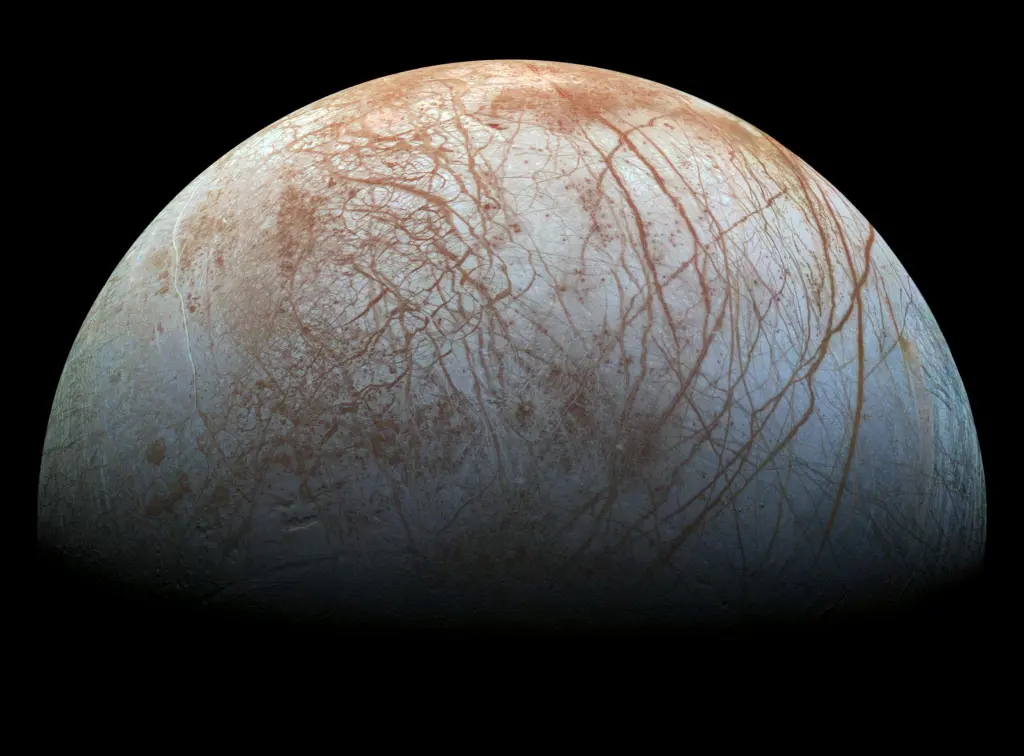
<p>Europa is one of the four moons of Jupiter discovered by Galileo Galilei (and Simon Marius) in 1610. Due to its smooth surface, scientists long suspected there to be a subsurface ocean and hopefully, life in the form of single-celled organisms and other bacteria-like creatures in that ocean.</p>

<p><img src="/img/europa.png" alt="Europa image" /></p>

<p style="text-align: center;"><i>An image of Europa taken by the Juno Spacecraft in 2022.</i></p>
<hr />

<h2 id="spectroscopy">Spectroscopy</h2>
<p>The Hubble Space Telescope discovered evidence of water vapor using a technique called ultraviolet spectroscopy. This method studies how light interacts with matter—especially in the ultraviolet (UV) range, which is invisible to the human eye.</p>

<p><img src="/img/hubble.jpeg" alt="Hubble Space Telescope image" /></p>

<p style="text-align: center;"><i>An image of the Hubble Space Telescope</i></p>

<p>In space, water molecules can break apart into hydrogen and oxygen atoms when exposed to energy like sunlight. This process, called photodissociation, happens often in places like icy moon plumes or thin atmospheres.</p>

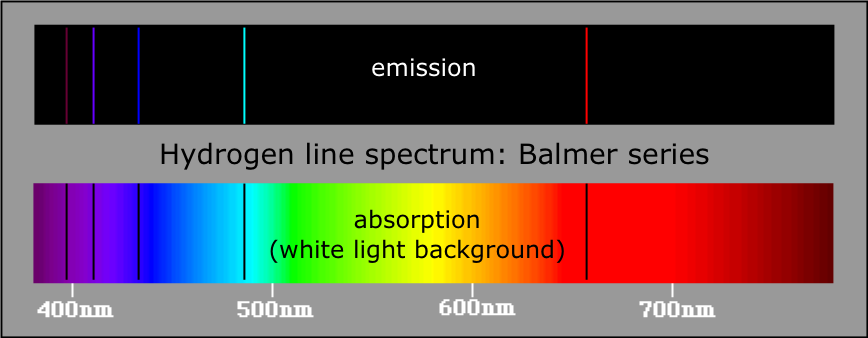
<p>When hydrogen and oxygen atoms form, they absorb and emit light at very specific UV wavelengths. These are like atomic fingerprints, and Hubble can detect them. By analyzing the light from distant objects, scientists found spectral lines that match those of hydrogen and oxygen, which strongly suggests that water vapor had recently broken apart nearby.</p>

<p><img src="/img/hy1.png" alt="Spectral Lines of Hydrogen image" /></p>

<p style="text-align: center;"><i>The spectral lines of Hydrogen</i></p>

<hr />

<h2 id="magnetic-field-measurements">Magnetic Field Measurements</h2>
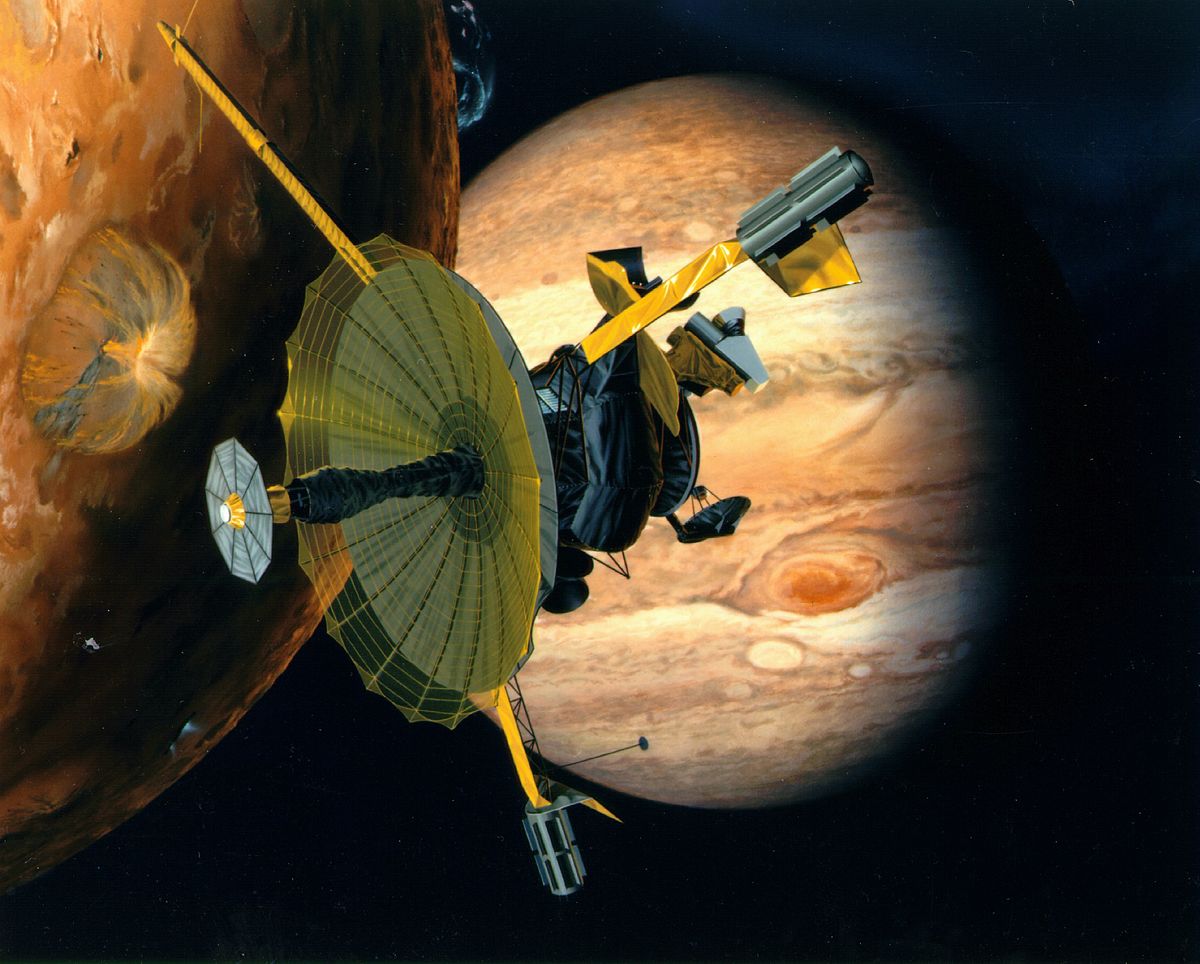
<p>When NASA’s Galileo spacecraft flew past Europa, its magnetometer detected an unexpected disturbance in Jupiter’s magnetic field near the moon. Under normal circumstances, Jupiter’s strong magnetic field should pass through a non-conductive body like rock or ice without much interference. However, the observed anomalies indicated that something within Europa was interacting with Jupiter’s field.</p>

<p><img src="/img/galileo.jpeg" alt="Galileo Spacecraft image" /></p>

<p style="text-align: center;"><i>An image of the Galileo Spacecraft</i></p>

<p>Using Maxwell’s equations—the fundamental laws governing electromagnetism—scientists modeled how a conductive material could induce its own magnetic field in response to Jupiter’s. The best explanation was the presence of a subsurface, electrically conductive layer. Since salty water is a good conductor of electricity, this led to the strong hypothesis that Europa has a global ocean of liquid, salt-rich water beneath its icy shell.</p>

<hr />

<h2 id="surface-geology-and-ice-movement">Surface Geology and Ice Movement</h2>

<p>High-resolution images from Galileo revealed a surface crisscrossed with long, intersecting cracks, ridges, and disrupted terrain that looks like floating icebergs. These features don’t resemble impact craters or typical tectonic processes. Instead, scientists applied physical modeling—specifically fracture mechanics, ice dynamics, and heat transfer equations—to understand these structures.</p>

<p><img src="/img/closeup1.jpg" alt="Closeup of Europa image" /></p>

<p style="text-align: center;"><i>A closeup image of Europa's surface showing the cracks and ridges mentioned</i></p>

<p>Their models showed that tidal flexing from Jupiter’s immense gravitational pull causes Europa’s interior to stretch and compress rhythmically. This mechanical stress generates frictional heating, particularly at the boundary between the icy shell and the underlying layer, which helps to maintain a liquid ocean. The shifting and cracking of the ice are consistent with behavior expected above a fluid or slushy layer, similar to how Earth’s polar ice sheets deform over oceans.</p>

<hr />

<h2 id="conclusion">Conclusion</h2>

<p>Thanks to a combination of tools—from magnetic field measurements to surface imaging and spectroscopic observations—scientists have gathered compelling evidence that Europa harbors a subsurface ocean beneath its icy crust. The Galileo spacecraft’s detection of a magnetic field disturbance pointed to a conductive liquid layer, likely salty water. Geological patterns observed on the surface support this, with models showing that tidal heating from Jupiter’s gravity could keep this ocean in a liquid state.</p>

<p>These discoveries make Europa one of the most promising places in our solar system to search for extraterrestrial life. As future missions like NASA’s Europa Clipper prepare to explore this icy world up close, each piece of evidence builds a stronger case that beneath Europa’s frozen exterior lies a dynamic, potentially habitable ocean world.</p>

<hr />

<h2 id="sources-and-further-reading">Sources and Further Reading</h2>

<p>Below are some sources I used throughout this short writeup as well as some interesting videos/articles I came across.</p>

<p><a href="https://youtu.be/DJO_9auJhJQ?feature=shared">We Might Find Alien Life In 2114 Days by Veritasium</a></p>

<p><a href="https://science.nasa.gov/jupiter/jupiter-moons/europa/">Europa by NASA</a></p>

<p><a href="https://europa.nasa.gov/why-europa/evidence-for-an-ocean/">Why Europa by NASA</a></p>]]></content><author><name>Srinidhi Srinivasasubbu</name></author></entry></feed>